

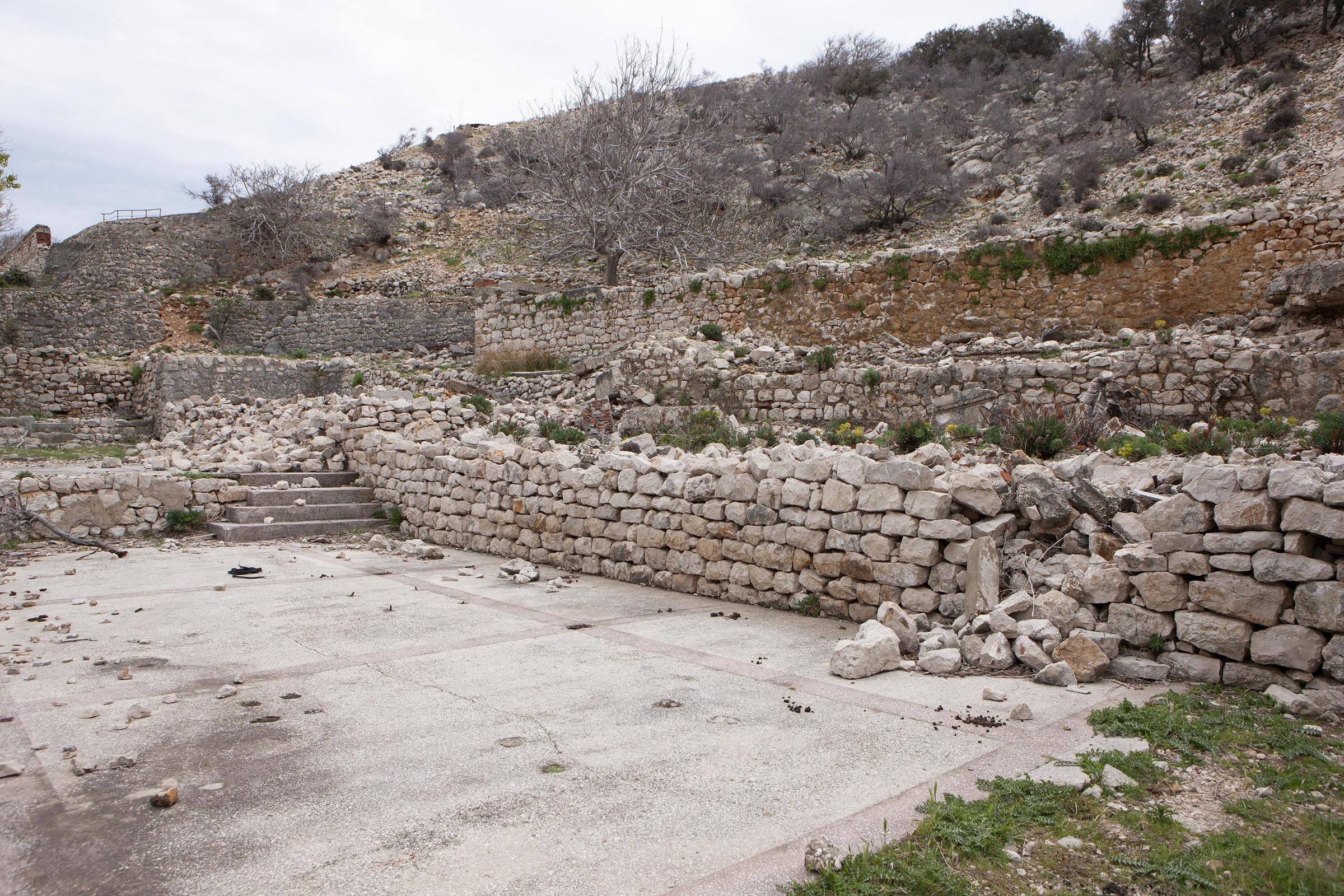
Political “re-education” on Goli otok was not an educational process but a system of controlled violence. A prisoner’s position, length of stay, type of work and chances of survival often depended on their readiness to publicly renounce their “IB-ist” guilt“IB-ist” guiltReal or alleged membership of the pro-Cominform current, i.e. support for the Cominform Resolution or opposition to Tito’s regime, for which a person was labelled an IB-ist (“ibeovac”). and to demonstrate loyalty to the party leadership.
The mechanisms included physical torture, ritual humiliation, imposed collective aggression, a strictly supervised hierarchy among prisoners, and working and climatic conditions as a permanent form of punishment. The system was set up so that the violence appeared to be an “internal” matter of the collective, while real control and direction were maintained through the power structure.
Hierarchy and mutual punishment
The camp functioned on the principle of hierarchy: the boycotted → the “deferred” (odloženi) → the “collective” → the “aktiv” → the activists. The boycottedBoycottThe bottom of the camp hierarchy and a punishment at the same time: the boycotted wore markings, no one was allowed to speak to them, and they could be beaten with impunity. were at the bottom of this hierarchical ladder – those who had just arrived and had not yet “revised” their political stance; “revising one’s stance” was the compulsory initial phase of political re-education. The “deferred” were a transitional category – those who had agreed to revise their stance and had entered the initial phase of the re-education procedure. Above the “deferred” came those with a better status in the camp, the so-called “collective”, “aktiv” and activists – the grades of the “revised”.
In narrower jargon the word “revised” was often applied specifically to the activists – those who had proven that they wanted to collaborate with the UDBAUDBAState Security Administration (Uprava državne bezbednosti) – the Yugoslav secret political police responsible for the surveillance and persecution of real or alleged opponents of the regime., the most privileged, involved in enforcing the order. The revised organised conferences, gauntlets and “lines”, passed on the demands of UDBA investigators and supervised punishments.
Fear of falling into boycott drove prisoners to take part in punishing others. In this way the camp turned prisoners into an instrument of control: survival became bound up with participation in the torture of others.
Boycott: the bottom of the hierarchy and legalised violence
Boycott was both a status and a punishment. The boycotted wore markings (e.g. a rag around the arm or a black shirt), could be beaten with impunity (and this was encouraged), no one was allowed to speak to them, and they had to walk with their heads bowed and stand in the corner at conferences.
They received even less food and water than the other prisoners and did the hardest work. They were also called the “gang”, in line with the UDBA’s belief that IB-ists (“ibeovci”)IB-ist (ibeovac)A real or alleged supporter of the Cominform Resolution, i.e. a sympathiser of Soviet policy in the period 1949–1956. always banded together in groups. In practice, boycott meant complete exposure to the “collective” and the “activists”: a person became a target.
Adding to the record and interrogation: the condition for “progress”
Adding to one’s written record (dopuna zapisnika) was the key condition for advancement in the camp hierarchy and for getting out of boycott. The UDBA held that IB-ists were connected in groups and that a prisoner knew other members still at liberty. The prisoner therefore had to compile a list of “IB-ists and sympathisers”, often friends, colleagues, neighbours or family members, under pressure to single out in particular the “hostile elements” in his own life. The prisoner wrote all of this into the record.
The record was also supplemented during interrogation: the prisoner would be summoned, or would report of his own accord, to the UDBA building, where he would talk to the interrogatorInterrogator (isljednik)The UDBA’s political investigator in the camp. Through interviews and written records he determined a prisoner’s “guilt” and monitored their “progress”., that is, the UDBA agent in the camp. In some cases the people named in the records also ended up in the camp.
After this phase, the prisoner who had “revised” his stance, now promoted to the status of “deferred” or “activist”, was expected to take part in “correcting” the boycotted. This included physical and verbal violence as well as various forms of humiliation. The reviser was expected to show disgust for and distance from the boycotted in this way.
Revising one’s stance: the price of escaping violence
Revising one’s stanceRevising one’s stancePublic “repentance” for views that the UDBA had declared anti-state, and consent to collaborate with the UDBA. It was a condition for advancement in the camp hierarchy. is a term meaning that a prisoner had repented of his views, which the UDBA had declared anti-state, and was ready to collaborate with the UDBA.
Revision was achieved through a combination of behaviours: taking part in the psychological and physical abuse of the boycotted, “snitching” on others, adding to the record, and distinguishing oneself through work and cooperation with the revised.
Cases in which someone did not revise his stance and was nevertheless released were rare.
In the camp mechanism loyalty was not a conviction but a performance: it had to be shown, repeated and confirmed, and in the form of violence against others.
Rituals of confession and public humiliation: the political hour and “stating one’s stance”
The central ritual was the evening political conference (the “political hour”). Often under the supervision of the room elder and an UDBA investigator, the prisoners took part in a public “trial” of a chosen individual. The person called out had to recount his life “up to the Cominform Resolution”, admit to “Stalinist sympathies” and accept the label of “IB-ist”.
The conference measured “activity”: the vehemence of verbal attacks on the USSR, the Cominform ResolutionCominform ResolutionThe 1948 political decision of the Cominform accusing Yugoslavia of deviating from the Soviet model of socialism, which led to the break with the USSR and the beginning of political persecution within the country. and “lukewarm comrades”. Any attempt at resistance was interpreted as “obstinacy”, including a prisoner’s claim of innocence. The outcome was often boycott – the bottom of the camp hierarchy.
It is important to stress that many ended up in the camp for trivial reasons (see the chapter Who Were the “IB-ists”). In such a framework “guilt” was not a legal fact but an UDBA decision that had to be admitted for any path towards “progress” in the camp hierarchy to open at all.
Collective lynching: the gauntlet, the “line” and the pavilion line
The term gauntlet (špalir)Gauntlet (špalir, stroj)Passage between two rows of prisoners who beat, spat on and insulted the person passing through; the “welcome” for new arrivals and a regular punishment. or “line” (stroj) meant passing between two rows of prisoners who beat, spat on and insulted the person passing through. It was the “welcome” for newly arrived prisoners, but also a regular punishment.
The ritual combined physical pain with the message that violence came “from within”, through the collective. If a prisoner fell, the attack did not stop but intensified.
In the gauntlet one could also sense who was trying to soften the blows. Some struck with “empty fists” or only pretended to strike, and this detail too became part of camp psychology: in the same row of people one could recognise a potential threat, but also a rare chance of relief.
In the later years of the camp the gauntlet was in places reduced to spitting and insults without physical violence. After the gauntlet, newcomers were ducked in a barrel of seawater contaminated with faeces and other filth.
Labour as a means of “re-education”: quotas and punishment through output
The hardest work (the quarry, carrying blocks, work on exposed parts of the island) was assigned to the boycotted and the “insufficiently revised”, while lighter work, assigned to the “aktiv”, was a reward for the “correct stance”.
Quotas had a political meaning: poorly performed work was interpreted as “incorrectness”, not exhaustion. Insufficient “effort” was presented as resistance to “the progress of Yugoslavia and the people”. In this way the physical limits of the body were turned into proof of political “guilt”.
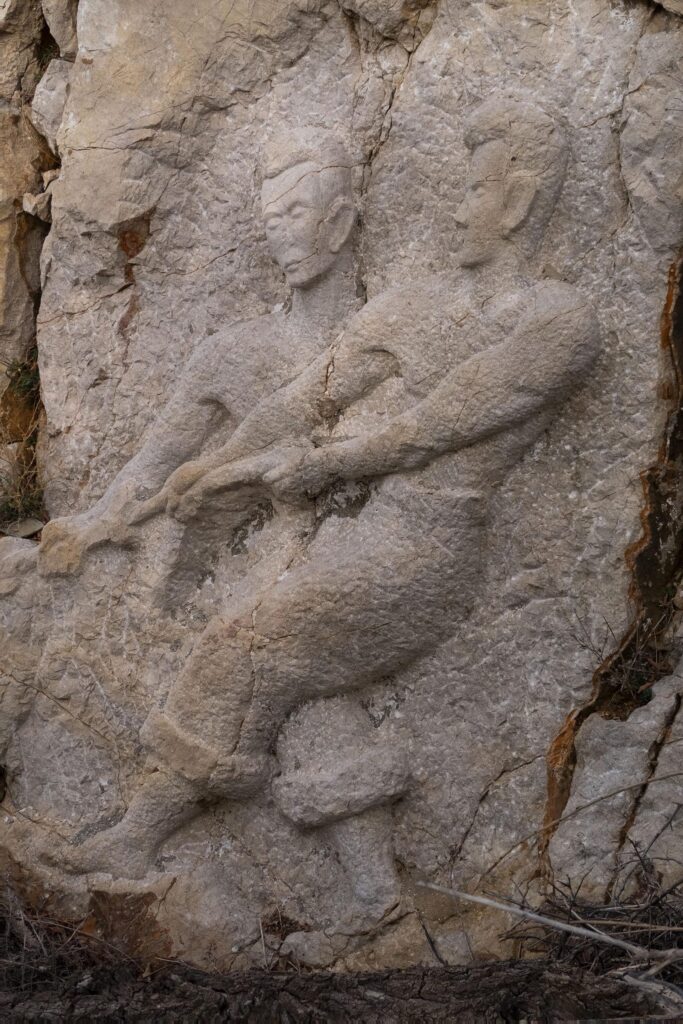
A particular form of labour was being driven with the tragačTragačA board or container fixed between two poles for carrying stone, water or faeces. The carriers were deliberately made to bear unequal loads. (stone-carrying stretcher), as the everyday tool for carrying stone, materials, water, faeces or urine was called. A board or container was fixed between two poles so that one prisoner carried the heavier part of the load (shorter handles) and the other the lighter part (longer handles) – the imbalance was part of the punishment.
Hunger, thirst and the body as a target
Very small food rations further broke the prisoners: polenta, beans, rarely fish. When prisoners showed physical effects of vitamin deficiencyVitamin deficiencyHypovitaminosis or avitaminosis – a prolonged lack of one or more vitamins. Its consequences include weakness and fatigue, lowered immunity, anaemia and bleeding, changes to the skin and mucous membranes, nerve damage and weakening of bones and muscles, in severe cases permanently., they were given pieces of onion or small apples. On top of everything else, many testify that the worst punishment was the lack of water.
Hunger and thirst were not merely a consequence of the conditions. In the logic of the camp they became an instrument: a way of keeping a person in a constant shortage of strength, in constant dependence, and in a state in which it was harder to think, harder to defy and harder to preserve one’s own dignity.
Climatic torture
Goli otok used its bare surface as a means of punishment. Work was done in the bora, in scorching heat and in rain, with minimal protection. Even “tree planting” could be a punishment: standing for hours in the sun or the bora, shielding the saplings with one’s own body, and exhaustion from work made harder by the rocky slopes.
Torture by noise: tension, sleeplessness and forced chanting
The day-long shouting of the elders, orders without respite, the din of conferences and the noise in the pavilions created a state of constant tension. Combined with sleeplessness and threats, the noise caused disorientation, loss of the sense of time and psychological breakdown.
During work the prisoners often had to sing party songs (e.g. “Comrade Tito, we pledge to you”) and chant slogans (“Thanks to Tito, the Party, the UDBA!”).
The prisoners sometimes also composed songs themselves, which they would sing. At times well-known melodies (operatic themes, foreign war songs) were given “Goli otok” lyrics.
Torture by sleep deprivation: the night as an extension of punishment
The prisoners had an intensive daily schedule of work and duties and did not sleep much.
The boycotted were often not allowed to sleep at all and would sleep next to the kibla (latrine bucket), while the punishment of “guarding the kibla” meant standing over it all night with head bowed, breathing in the foul smell of urine and faeces.
After exhausting work prisoners would sometimes be allowed to fall asleep and then deliberately woken for questioning about their “views” and “enemies”. They slept on straw mattresses, which was particularly hard during the bora and in winter.
“Camp performances”, cinema and propaganda: the public stage as discipline
Under coercion, sketches and parodies of the prisoners’ lives were performed. The audience’s laughter was part of the punishment, and the activists assessed “fervour” – too little enthusiasm meant the risk of a return to boycott. Sometimes well-known literary works were adapted in order to humiliate particular prisoners and incite further violence.
The camp also had a cinema hall. Screenings often took place after exhausting work; prisoners would fall asleep and then be beaten for “boycotting” the instruction that the PartyKPJCommunist Party of Yugoslavia (Komunistička partija Jugoslavije). provided through film. The UDBA showed foreign, Western-produced films.
The wall newspaper (“Goli otočke novine”) published the names of the “unreformed”, caricatures of the boycotted and comments on behaviour. Reactions (laughter, silence, looking away) were recorded.
Disfigurement
Uniforms were often deliberately ill-fitting (trousers too short or too long), which made work harder and increased exposure. Hair was cut with crude shears (for sheep’s wool) or pulled out. Footwear was too tight or too wide, so prisoners often worked barefoot.
Clothing and footwear contributed to wounds, burns and exhaustion. These “minor” tortures were not incidental: they were a constant reminder that the body was under someone else’s control and that humiliation was carried out through details as well.
Other punishments and individual experiences
Besides the methods described, there were other punishments: flogging, carrying loads despite injuries, beating with poles, fights between prisoners and various improvised tortures.
It is essential to say that every prisoner had a unique experience of violence.
Glossary
- “IB-ist” guilt
- Real or alleged membership of the pro-Cominform current, i.e. support for the Cominform Resolution or opposition to Tito’s regime, for which a person was labelled an IB-ist (“ibeovac”).
- Boycott
- The bottom of the camp hierarchy and a punishment at the same time: the boycotted wore markings, no one was allowed to speak to them, and they could be beaten with impunity.
- UDBA
- State Security Administration (Uprava državne bezbednosti) – the Yugoslav secret political police responsible for the surveillance and persecution of real or alleged opponents of the regime.
- IB-ist (ibeovac)
- A real or alleged supporter of the Cominform Resolution, i.e. a sympathiser of Soviet policy in the period 1949–1956.
- Interrogator (isljednik)
- The UDBA’s political investigator in the camp. Through interviews and written records he determined a prisoner’s “guilt” and monitored their “progress”.
- Revising one’s stance
- Public “repentance” for views that the UDBA had declared anti-state, and consent to collaborate with the UDBA. It was a condition for advancement in the camp hierarchy.
- Cominform Resolution
- The 1948 political decision of the Cominform accusing Yugoslavia of deviating from the Soviet model of socialism, which led to the break with the USSR and the beginning of political persecution within the country.
- Gauntlet (špalir, stroj)
- Passage between two rows of prisoners who beat, spat on and insulted the person passing through; the “welcome” for new arrivals and a regular punishment.
- Tragač
- A board or container fixed between two poles for carrying stone, water or faeces. The carriers were deliberately made to bear unequal loads.
- Vitamin deficiency
- Hypovitaminosis or avitaminosis – a prolonged lack of one or more vitamins. Its consequences include weakness and fatigue, lowered immunity, anaemia and bleeding, changes to the skin and mucous membranes, nerve damage and weakening of bones and muscles, in severe cases permanently.
- KPJ
- Communist Party of Yugoslavia (Komunistička partija Jugoslavije).